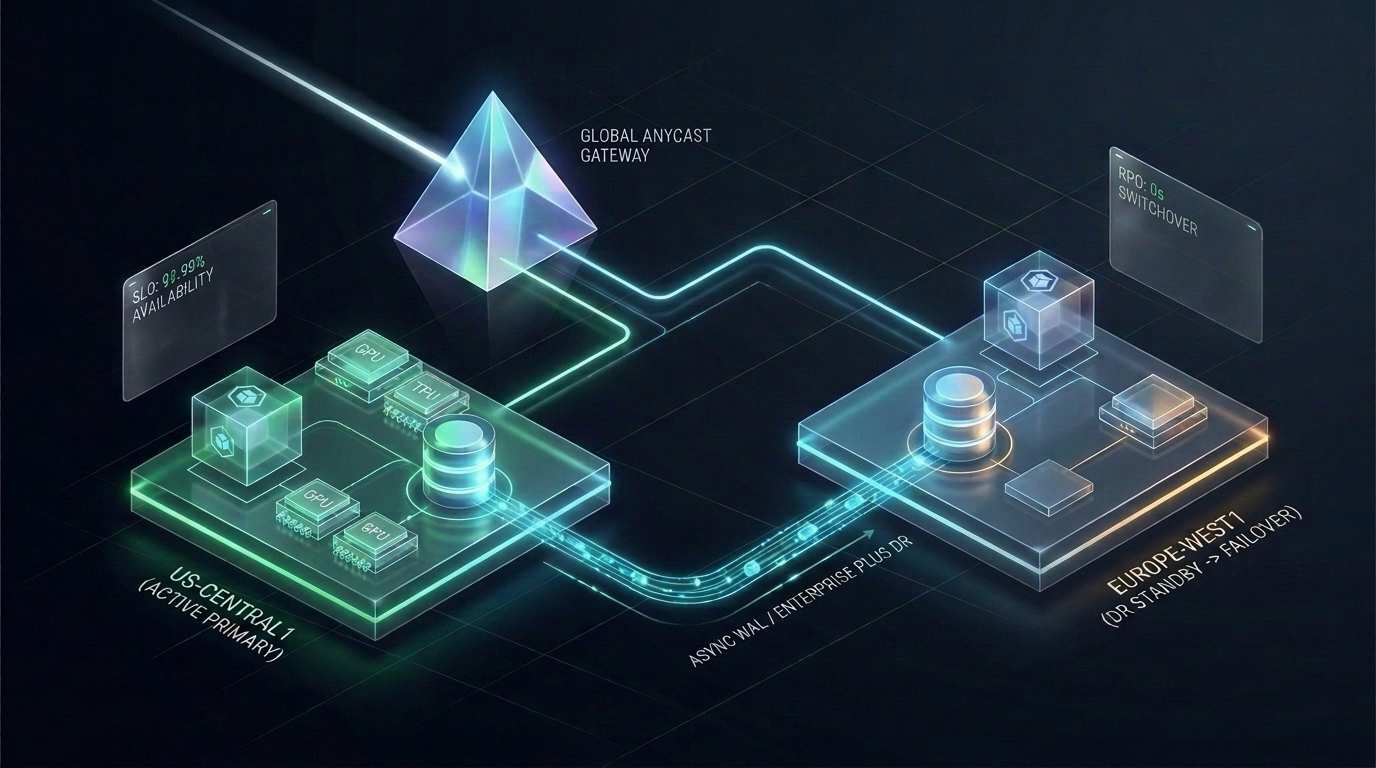
In cloud engineering, we spend a great deal of time configuring High Availability (HA) within a single region: spreading GKE nodes across three zones, attaching regional persistent disks, and enabling synchronous zonal standby on Cloud SQL. For internal dashboards and tier-2 services, single-region HA (99.9% to 99.95% uptime) is sufficient.
Until an entire region goes dark.
Regional outages rarely require a natural disaster. In practice, they are triggered by control-plane configuration cascades, subsea fibre cuts, regional networking brownouts, or regional GPU and model endpoint quota exhaustion during a traffic spike.
For mission-critical workloads such as banking rails, healthcare systems, and stateful enterprise AI agents executing real-world transactions, 99.9% uptime is an admission that nearly nine hours of downtime a year is acceptable. Reaching 99.99% ("Four Nines") shrinks your annual error budget to just 52.6 minutes. You cannot achieve Four Nines inside a single region. You need a Multi-Regional Disaster Recovery (DR) architecture.
In this article, we will examine the availability mathematics and network physics that govern multi-region systems, compare legacy Kubernetes failover patterns against modern Google Cloud primitives, and build an Active-Passive / Warm-Standby architecture across us-central1 and europe-west1 using GKE Multi-Cluster Gateways, GKE Inference Gateways, Config Sync, Backup for GKE, and Cloud SQL Enterprise Plus Advanced DR.
The Mathematics of 99.99% and the Physics of State
Before writing a single line of YAML, we must look at the numbers. Multi-regional architecture is governed by two hard constraints: composite SLA probability and the speed of light in optical fibre.
The Availability Budget
| Availability Tier | Allowable Downtime / Year | Allowable Downtime / Month | Allowable Downtime / Week | Reference Google Cloud Topology |
|---|---|---|---|---|
99.9% (Three Nines) | 8 hours, 45 minutes | 43.8 minutes | 10.1 minutes | Single-Region Zonal GKE |
99.95% (Three-and-a-Half Nines) | 4 hours, 22 minutes | 21.9 minutes | 5.0 minutes | Regional GKE (Multi-Zone) + Cloud SQL Regional HA |
99.99% (Four Nines) | 52.6 minutes | 4.38 minutes | 1.01 minutes | Multi-Region GKE Fleet + Global LB Failover + Cross-Region DB DR |
99.999% (Five Nines) | 5.26 minutes | 26.3 seconds | 6.05 seconds | Multi-Region Active-Active + Cloud Spanner |
Why can't a single region deliver 99.99%? Because availability in a single region is a serial product of dependent services. Under Google Cloud's published SLAs, both a Regional GKE control plane and a Regional HA Cloud SQL instance offer 99.95% availability. When your application depends on both in series within a single region, your composite availability ceiling drops to 99.90% (0.9995 × 0.9995 ≈ 0.9990), or roughly 8.76 hours of potential downtime per year.
In a multi-regional topology, your effective availability is bounded by your Recovery Time Objective (RTO): the total time required to detect a regional failure, drain traffic at the load balancer, promote the standby database, and serve requests from warm compute capacity:
When your monthly error budget at 99.99% is 4 minutes and 23 seconds (263 seconds), any architecture that relies on scaling standby GPU nodes from 0 or manually editing database IP addresses in a ConfigMap will breach its SLA on the first outage.
Architecture Overview: The "Old" vs. "New" Multi-Region Stack
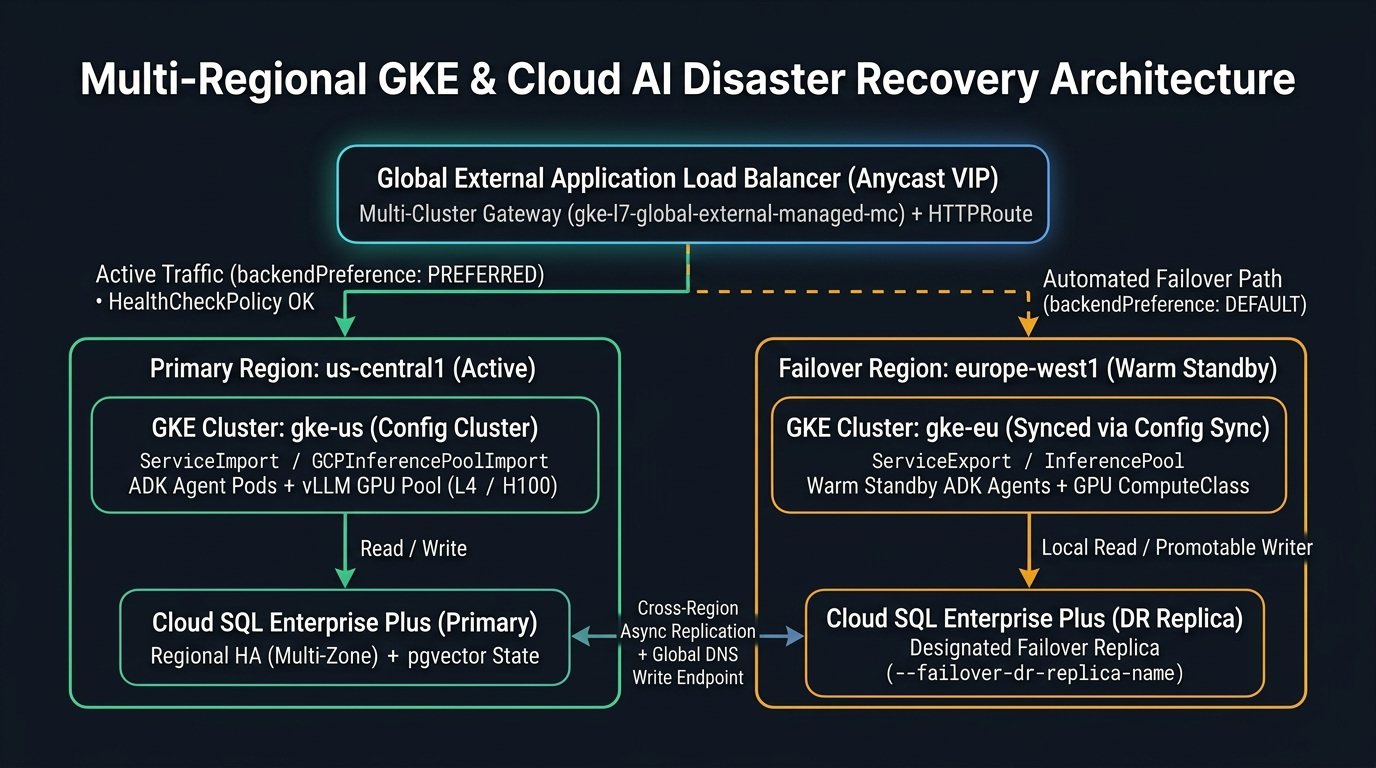
Let's design our target architecture across two regions:
- Primary Region (
us-central1): Hostsgke-us(Active application and inference pool) andprimary-db(Cloud SQL Enterprise Plus Primary with Regional Multi-Zone HA). - Failover Region (
europe-west1): Hostsgke-eu(Warm standby application and inference pool) andfailover-replica(Cloud SQL Enterprise Plus designated DR Replica).
Why Multi-Cluster Gateway (MCG) Replaces Multi-Cluster Ingress (MCI)
Many older GKE disaster recovery guides rely on MultiClusterIngress (MCI) and MultiClusterService (MCS). While Google Cloud continues to support MCI for existing clusters, Multi-Cluster Gateway (MCG), built on the upstream Kubernetes Gateway API, is the production standard for multi-cluster traffic management.
| Capability | Legacy Multi-Cluster Ingress (MCI) | Modern Multi-Cluster Gateway (MCG) |
|---|---|---|
| API Standard | Proprietary CRD (networking.gke.io/v1 MultiClusterIngress) | Upstream Kubernetes Gateway API (Gateway, HTTPRoute) |
| Service Discovery | Custom MultiClusterService object in config cluster | Standard Kubernetes ServiceExport & ServiceImport (net.gke.io/v1) |
| Load Balancer Scope | External HTTP(S) Load Balancer only | Global External (gke-l7-global-external-managed-mc) & Cross-Region Internal (gke-l7-rilb-mc) |
| Active-Passive Control | Manual cluster link editing (spec.clusters) or scaling pods to 0 | Declarative GCPBackendPolicy scopes (backendPreference: PREFERRED vs DEFAULT) & weighted HTTPRoute |
| Cloud AI & LLM Support | Unaware of LLM queue depth or KV-cache locality | Native integration with GKE Inference Gateway (InferencePool, GCPInferencePoolImport, IN_FLIGHT balancing) |
| Role Separation | Monolithic single-manifest configuration | Decouples Platform NetOps (Gateway, GCPGatewayPolicy) from App/AI Teams (HTTPRoute, GCPBackendPolicy) |
Step-by-Step Implementation Guide
Phase 1: Fleet Foundation, Regional Clusters & Config Sync
1. Enable Required Google Cloud APIs
Enable the GKE, Fleet (gkehub), Multi-Cluster Services, Multi-Cluster Ingress/Gateway, Traffic Director, Certificate Manager, Backup for GKE, Cloud SQL Admin, and Gemini Enterprise Agent Platform (aiplatform) APIs:
2. Provision Regional VPC-Native GKE Clusters
Always use Regional GKE clusters so that a single zone failure is absorbed locally without triggering a cross-region failover. Pass --gateway-api=standard, --enable-fleet, and --addons=HttpLoadBalancing,BackupRestore at creation time:
3. Enable Fleet Multi-Cluster Services (MCS) & Designate the Config Cluster
For ServiceExport and ServiceImport resources to discover endpoints across gke-us and gke-eu, enable Multi-Cluster Services on the Fleet, bind the gke-mcs-importer Workload Identity role, and designate gke-us as the initial Config Cluster:
Phase 2: Global Traffic Management with Multi-Cluster Gateway
1. Export the Service from Both Clusters
In both gke-us and gke-eu, deploy your application pods, expose a standard ClusterIP Service, and apply a ServiceExport so the Fleet MCS controller exports the Pod Network Endpoint Groups (NEGs) globally:
Once ServiceExport is applied on both clusters, the Fleet controller automatically generates a ServiceImport resource (kind: ServiceImport, group: net.gke.io) across the fleet, aggregating the container-native NEGs from both us-central1 and europe-west1.
2. Provision the Global Gateway, HTTPRoute, and Active-Passive Policies
By default, a global load balancer routes users to the geographically closest healthy cluster (Active-Active). Because our primary relational database lives in us-central1 (primary-db), routing a European user's write-heavy session to europe-west1 during normal operations would force every database query in that session to cross the Atlantic back to us-central1 ("traffic tromboning").
To enforce Active-Passive routing where steady-state traffic stays pinned to us-central1 while europe-west1 stands by warm, we combine our Gateway (gke-l7-global-external-managed-mc) and HTTPRoute with a GCPBackendPolicy and a tuned HealthCheckPolicy:
By tuning checkIntervalSec: 5 and unhealthyThreshold: 2 against /readyz (instead of relying on default 15-second intervals), the global load balancer detects a regional failure and drains traffic to europe-west1 in 10 to 15 seconds.
Phase 3: The Cloud AI Layer: Multi-Regional Inference & Agent Routing
As a Cloud AI architect, this is where generic Kubernetes DR guides fall short. Modern AI workloads on GKE rely on two distinct intelligence planes, and both require explicit multi-regional failover design:
- Managed Foundation Models (calling Gemini models via the Google GenAI SDK on the Gemini Enterprise Agent Platform).
- Self-Hosted Open Models on GKE (serving Gemma or Llama on
vLLMwith GPUs or TPUs behind the GKE Inference Gateway).
Pattern A: Eliminating Regional SPOFs in Managed Gemini API Calls
If your GKE pods fail over from us-central1 to europe-west1 in 12 seconds, but your Agent Development Kit (ADK) service is hardcoded to GOOGLE_CLOUD_LOCATION="us-central1", your agent will still fail if the us-central1 model endpoint is experiencing an outage or quota exhaustion.
- Use the Global Endpoint (
location="global") on the Gemini Enterprise Agent Platform: Unless strict regional data-residency regulations forbid cross-region inference, configureGOOGLE_GENAI_USE_ENTERPRISE=trueandGOOGLE_CLOUD_LOCATION="global". The Global Endpoint automatically routes around regional model-serving brownouts to regions with available capacity. - Regional Fallback Circuit Breaker: When data residency requires regional endpoints, inject the pod's local region as primary and configure an automatic fallback client using
enterprise=True:
Pattern B: Multi-Cluster GKE Inference Gateway & Warm GPU Pools
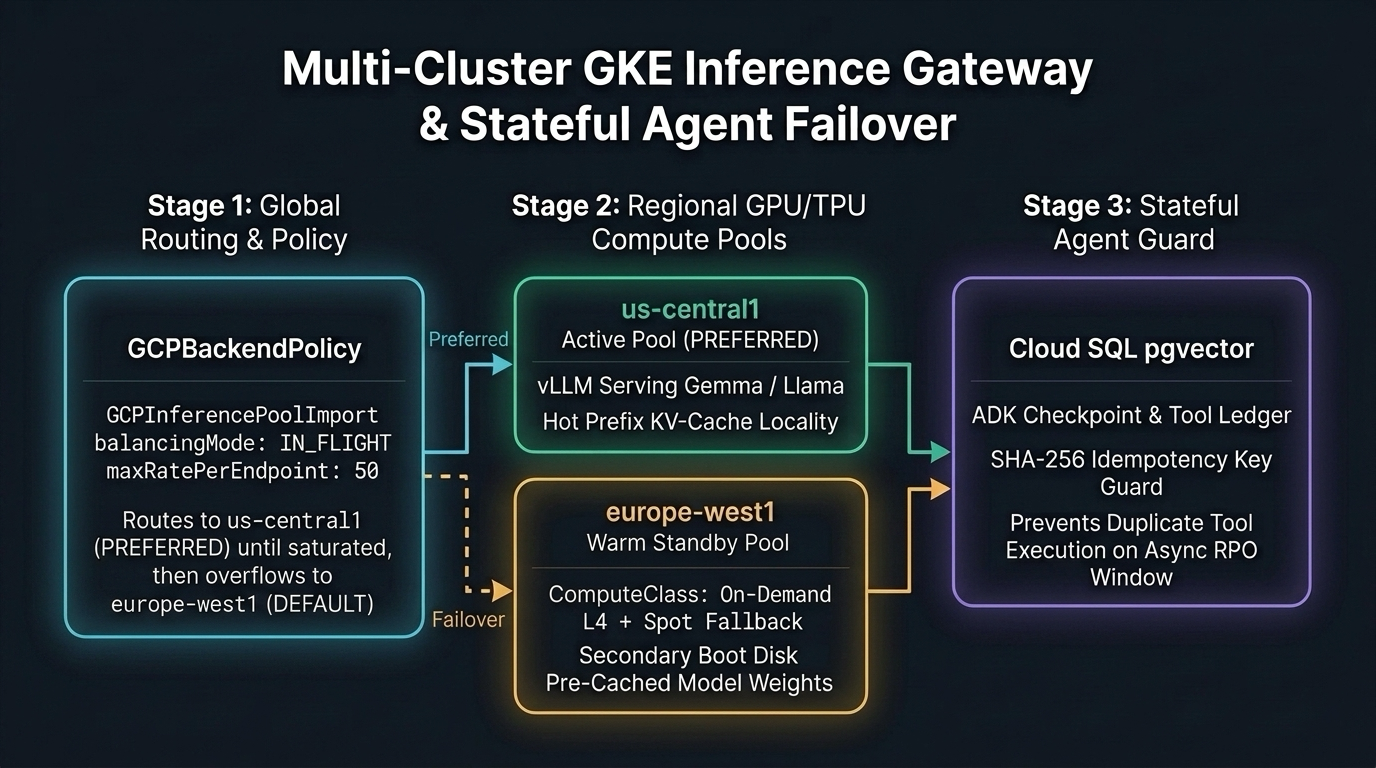
If you self-host open models on GKE using vLLM, standard HTTP load balancing and cold standby (replicas: 0) create three severe problems during failover:
- LLM Requests Vary Wildly in Duration: A short classification prompt takes 150 ms; a long-context agent reasoning trace takes 15 seconds. Standard request-per-second (RPS) balancing overloads GPU pods. Attach a
GCPBackendPolicywithbalancingMode: IN_FLIGHTto aGCPInferencePoolImportresource so routing tracks active in-flight requests. - KV-Cache Locality: Splitting traffic 50/50 across regions during steady state ruins
vLLMprefix KV-cache hit rates. Pinning primary traffic tous-central1(backendPreference: PREFERRED) keeps the prefix cache hot. - GPU Provisioning & Weight-Loading Latency: Scaling a GPU deployment from
0during a disaster requires node provisioning, pulling multi-gigabyte container images, and loading model weights into VRAM. Maintain a warm minimum replica pool ineurope-west1backed by a GKEComputeClassthat cascades from On-Demand GPUs to Spot GPUs if regional capacity tightens during an evacuation:
Phase 4: The Stateful Data Layer: Cloud SQL Enterprise Plus Advanced DR & Backup for GKE
Stateless containers move across regions in seconds; stateful databases and persistent volumes require deliberate choreography.
In older Cloud SQL architectures, cross-region recovery relied on running gcloud sql instances promote-replica against a standard read replica. That legacy workflow has three operational drawbacks:
- It is destructive: Promoting a standard read replica permanently severs replication from the old primary. Once
us-central1recovers, you must manually rebuild and re-seed the old primary from a full backup. - Routine DR drills are disruptive: Because
promote-replicabreaks the replication topology, teams avoid testing cross-region failover regularly. - Manual endpoint updates: Applications must be reconfigured with the promoted instance's IP address and restarted.
Cloud SQL Enterprise Plus Advanced Disaster Recovery
Cloud SQL Enterprise Plus edition introduces Advanced DR, which replaces destructive promotion with reversible switchover, automated failover topology recovery, and a Global DNS Write Endpoint:
| Capability | Cloud SQL Enterprise (Standard Replica) | Cloud SQL Enterprise Plus (Advanced DR) |
|---|---|---|
| Failover Replica Designation | None (any read replica is manually promoted) | Explicit designated DR replica (--failover-dr-replica-name) |
Planned DR Drill (switchover) | Not supported (must sever link with promote-replica) | Zero-Data-Loss (RPO = 0) Role Reversal (gcloud sql instances switchover) |
| Topology After Switchover | Broken; requires full manual rebuild of old primary | Automatic reversal: old primary automatically becomes replica of new primary |
Unplanned Outage (failover) | promote-replica orphans old primary | gcloud sql instances failover promotes DR replica and re-links old primary upon recovery |
| Application Connection Routing | Manual IP / ConfigMap update + pod restart | Global DNS Write Endpoint automatically repoints writer DNS record to active primary |
| Point-in-Time Recovery (PITR) | Up to 7 days retention | Up to 35 days retention + sub-second WAL replay |
1. Provision the Enterprise Plus Primary and Designated DR Replica
2. Planned Zero-Data-Loss switchover vs. Unplanned failover
With Advanced DR configured and your pods connecting via the Global DNS Write Endpoint, database promotion never requires a ConfigMap edit:
-
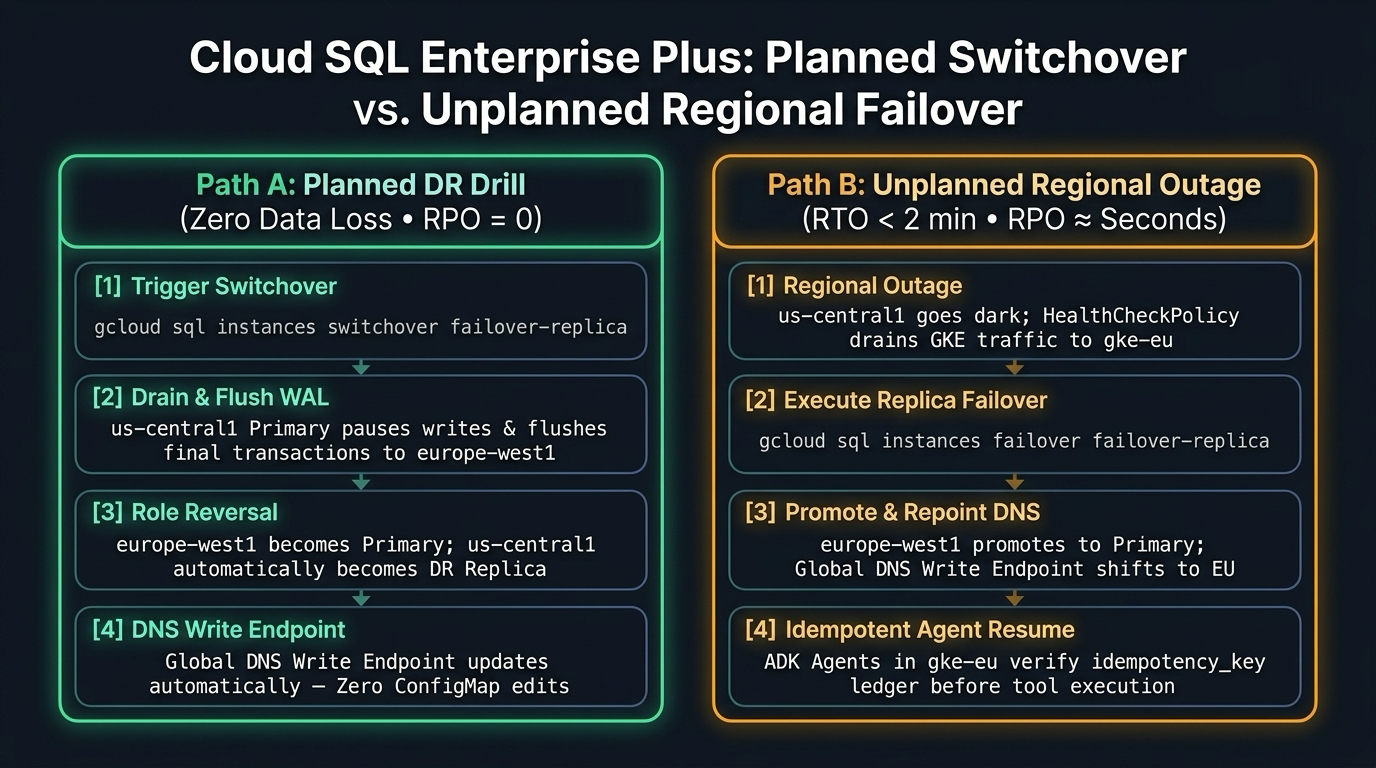
Scenario A: Planned DR Drill or Regional Maintenance (
RPO = 0): Runswitchoverto verify your DR readiness with zero data loss:bash•Executing a Zero-Data-Loss Planned Switchover (RPO = 0)123gcloud sql instances switchover failover-replica \--db-timeout=300s \--project=${PROJECT_ID}Cloud SQL pauses writes on
primary-db, flushes all remaining WAL records tofailover-replicaineurope-west1, promotesfailover-replicato Primary, automatically demotesprimary-dbinto a replica streaming from Europe, and updates the Global DNS Write Endpoint. When your drill completes, rungcloud sql instances switchover primary-dbto reverse roles back. -
Scenario B: Unplanned Regional Outage (
us-central1Unreachable): When the primary region is offline, trigger an immediate Replica Failover:bash•Executing an Unplanned Emergency Cross-Region Failovergcloud sql instances failover failover-replica \--project=${PROJECT_ID}failover-replicaimmediately promotes to Primary and claims the Global DNS Write Endpoint.
3. Protect In-Cluster Persistent Volumes & Secrets with Backup for GKE
Config Sync replicates declarative Git manifests, but it does not replicate runtime PersistentVolumeClaims (PVCs) or dynamically generated Kubernetes Secrets. For those in-cluster stateful resources, create a cross-region BackupPlan targeting europe-west1:
Phase 5: Idempotent Tool Execution for Stateful AI Agents
There is one subtle edge case left in any multi-regional architecture where database replication is asynchronous (RPO > 0 during an unplanned regional outage): stateful agent replay.
Suppose an ADK agent in us-central1 executes an external mutating tool call (such as creating an order or booking a resource) and commits the resulting conversation checkpoint locally to primary-db. If us-central1 suffers an abrupt blackout a few milliseconds later, before that asynchronous WAL record finishes crossing the Atlantic to europe-west1, the newly promoted failover-replica will hold the conversation checkpoint from just before the tool call completed. When the session resumes on gke-eu, the agent will attempt to execute that tool step again.
To ensure that an unplanned cross-region failover never causes duplicate external side effects, bind every mutating agent tool call to a deterministic idempotency key derived from the session ID, turn index, tool name, and canonical arguments:
If an agent turn is replayed in europe-west1 after an unplanned regional failover, it computes the exact same Idempotency-Key, allowing the downstream API to return the existing receipt without duplicating the transaction.
Architectural Comparison Summary
| Dimension | Single-Region HA (us-central1 only) | Legacy Multi-Region (MCI + Cold Standby + promote-replica) | Modern Multi-Region (MCG + Warm AI Pool + Enterprise Plus Advanced DR) |
|---|---|---|---|
| Target Availability | 99.90% - 99.95% | 99.95% (high RTO during cold starts and manual promotion) | 99.99%+ (< 52.6m allowable downtime/year) |
| Global Traffic Routing | Single-region Ingress | Proprietary MultiClusterIngress (MCI) | Upstream Gateway API (gke-l7-global-external-managed-mc) |
| Active-Passive Mechanism | N/A | Manual spec.clusters edits or replicas: 0 | Declarative GCPBackendPolicy (backendPreference: PREFERRED) |
| Control Plane Failover Safety | N/A | Risk of LB deletion if Config Cluster is repointed unsynced | Zero disruption (Gateway CRDs mirrored via Config Sync) |
| AI Inference Routing | Single-region endpoint | Standard CPU/RPS balancing; cold GPU scaling | GCPInferencePoolImport (IN_FLIGHT) + Warm ComputeClass Pool |
| Planned Database DR Drill | Not applicable | Destructive (promote-replica severs replication) | Zero-Data-Loss Role Reversal (gcloud sql instances switchover) |
| Database Connection Routing | Static regional IP | Manual ConfigMap IP update + pod restart | Automatic (Global DNS Write Endpoint) |
| Stateful Agent Replay Safety | Local transaction commit | Vulnerable to duplicate tool calls during async RPO window | Protected via deterministic SHA-256 tool Idempotency-Key |
Conclusion
Achieving 99.99% availability across regions is not about duplicating clusters and hoping a global load balancer figures out the rest. It requires designing around the speed of light, eliminating hidden single points of failure in your control planes and model endpoints, and coordinating stateful failover without manual configuration edits.
By combining GKE Multi-Cluster Gateways (backendPreference: PREFERRED), GKE Inference Gateways (balancingMode: IN_FLIGHT), Config Sync, Cloud SQL Enterprise Plus Advanced DR (switchover and failover), and idempotent agent tool ledgers, you transform multi-regional disaster recovery from a high-risk manual scramble into a repeatable, verifiable engineering discipline.
References & Further Reading
- GKE Multi-Cluster Gateway: Deploying Multi-Cluster Gateways on GKE
- GKE Inference Gateway: About GKE Inference Gateway for AI/ML Workloads
- Cloud SQL Enterprise Plus Advanced DR: Use Advanced Disaster Recovery (Switchover and Failover)
- Backup for GKE: Plan a Set of Backups across Regions
- Gemini Enterprise Agent Platform: Supported Locations & Global Endpoint Routing
- Agent Development Kit (ADK): Official ADK Documentation