In May 2026, I wrote Scaling Beyond Rehosting: Transitioning from GCE to GKE with Cloud Service Mesh. That guide took a classic VM-based workload onto Google Kubernetes Engine (GKE) and layered Cloud Service Mesh over it using istio-injection=enabled, Envoy sidecar proxies in every Pod, Istio PeerAuthentication, and VirtualService manifests.
Even then, the trade-off was obvious in the architecture's Cons section: sidecar proxies consume CPU and memory per Pod and add single-digit-millisecond latency (on top of coupling proxy upgrades directly to application Pod lifecycles). I noted at the time that node-level ambient proxies were moving to solve this.
Six months later, two Google Cloud releases have reshaped the GKE service mesh landscape:
- 28 September 2026: Cloud Service Mesh officially deprecated both the managed and in-cluster
ISTIODcontrol planes on GKE, setting an end-of-support deadline of 1 March 2028 and standardising managed Cloud Service Mesh on theTRAFFIC_DIRECTORcontrol plane. - 21 November 2026: Google Cloud announced the general availability (GA) of ambient networking for GKE, paired with Network Services Monitoring (Preview) in Network Intelligence Center.
If you are planning a new GKE mesh deployment or revisiting a sidecar architecture built around istio-injection=enabled, the default path on GKE has changed. Just as importantly, the new model is not simply upstream Istio Ambient Mesh (ztunnel) rebranded. It is a GKE-native, sidecarless Layer 4 implementation built directly into GKE Dataplane V2 (DPv2), Traffic Director, Certificate Authority Service (CAS), and the Kubernetes Gateway API.
Sidecars vs Native GKE Ambient Networking
Before diving into YAML and CLI flags, it helps to put the May 2026 approach next to the November 2026 GA architecture.
| Dimension | Legacy Sidecar Mesh (May 2026) | Native GKE Ambient Networking (Nov 2026 GA) |
|---|---|---|
| Data plane | Per-Pod Envoy sidecar container injected into every workload Pod | Shared per-node DaemonSets (gke-ambient-nriplugin and gke-ambient-proxy) in gke-managed-ambient |
| Traffic interception | Init container / iptables rules inside each Pod network namespace | Node Resource Interface (NRI) plugin integrated with GKE Dataplane V2 |
| Control plane | Managed or in-cluster ISTIOD (deprecated on GKE; end of support 1 March 2028) | Traffic Director (xDS), GKE Gateway Controller, GKE Cluster Control Plane, and CAS |
| Policy and routing APIs | Istio CRDs (PeerAuthentication, VirtualService, AuthorizationPolicy) | Kubernetes Gateway API and networking.gke.io/v1 CRDs (GCPServerTLSPolicy, GCPClientTLSPolicy, GCPAuthzPolicy); Istio APIs are not supported |
| Namespace enrolment | istio-injection=enabled (requires Pod restart to inject/upgrade) | networking.gke.io/dataplane-mode=ambient (no sidecar container injected) |
| CVE patching & lifecycle | Shared fate with application containers; proxy upgrades restart workload Pods | Decoupled from application Pods; updated alongside GKE control-plane maintenance |
| Resource overhead | Linear per-Pod CPU and memory footprint | Shared per-node L4 proxy; Google Cloud reports up to 90% lower CPU and memory overhead (up to a 10x reduction for L4 mesh features) |
| Operational scope | L4 + L7 routing, multi-cluster mesh, hybrid GCE/Cloud Run backends | Single-cluster Layer 4 mesh today; cannot interoperate with sidecar-injected workloads or proxyless gRPC |
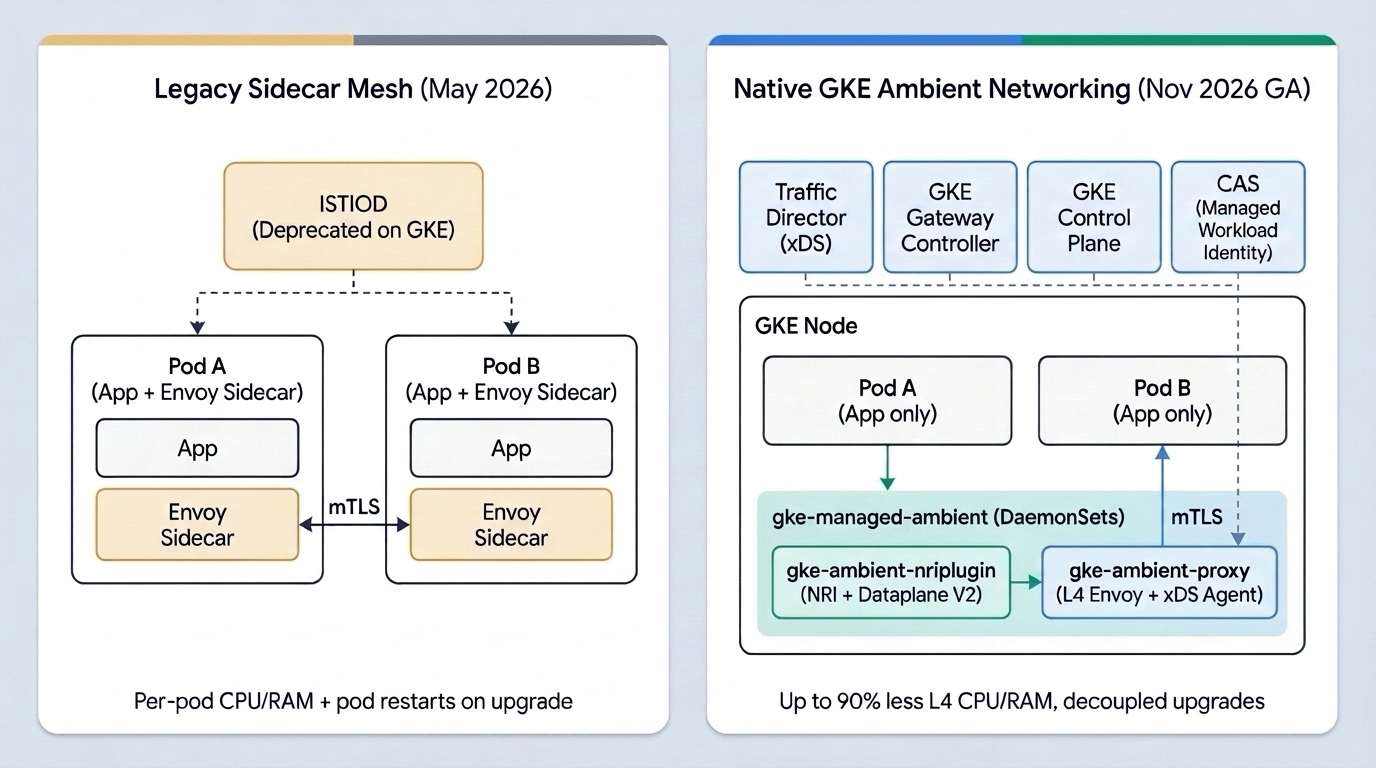 Figure 1: Sidecar injection versus native GKE ambient networking on Dataplane V2. Per-Pod Envoy sidecars and ISTIOD give way to node-level gke-ambient-nriplugin and gke-ambient-proxy DaemonSets driven by Traffic Director, the GKE Gateway Controller, and Certificate Authority Service.
Inside the Native Ambient Architecture
The core shift in GKE ambient networking is moving mesh enforcement out of the Pod and into two clearly separated layers: a Google-managed control plane and a shared per-node data plane.
Control Plane Components
- Traffic Director: Acts as the centralised xDS control plane, pushing routing configuration, TLS policies, and L4 authorisation rules to the node proxies.
- GKE Gateway Controller: Watches Kubernetes Gateway API and
networking.gke.io/v1custom resources in your cluster and translates them into managed Google Cloud API objects for Traffic Director. - Certificate Authority Service (CAS) & Managed Workload Identity: Authenticates workload identities and dynamically issues short-lived X.509 SPIFFE certificates on demand.
- GKE Cluster Control Plane: Approves
CertificateSigningRequest(CSR) objects (using signerspiffe.gke.io/fleet-svid) and routes them to CAS.
When you apply Kubernetes resources on the cluster, the GKE Gateway Controller automatically materialises regional Google Cloud API resources behind the scenes:
| Capability | Managed Google Cloud API Resource | Scope & Cardinality |
|---|---|---|
| Mesh boundary | Mesh | Regional, 1 per cluster |
| Service routing | TCPRoute | Regional, 1 per cluster, plus 1 per Service targeted by a GCPClientTLSPolicy |
| Service representation | BackendService | Regional, 1 per cluster |
| Client authentication | ClientTlsPolicy | Regional, 1 per cluster |
| Server authentication | ServerTlsPolicy & EndpointPolicy | Regional, 3 ServerTlsPolicy per cluster; 1 EndpointPolicy per GCPServerTLSPolicy plus 1 per distinct mTLS mode in portOverrides |
| Authorisation | AuthzPolicy | Regional, 1 per Pod targetRef in each GCPAuthzPolicy with enforcementLevel: L4 |
| Egress routing (Preview) | EgressRouting | Regional, 1 per namespace with a GCPEgressPolicy |
Node-Level Data Plane (gke-managed-ambient)
On each cluster node, GKE installs two DaemonSets inside the gke-managed-ambient namespace, patched and upgraded alongside normal GKE maintenance:
gke-ambient-nriplugin: Integrates with the container runtime via the Node Resource Interface (NRI) to perform low-level traffic interception and redirection for ambient-enrolled Pods.gke-ambient-proxy: Houses the xDS agent (which receives configuration from Traffic Director and fetches workload certificates on demand from the GKE control plane) and a shared, node-level Layer 4 Envoy proxy that terminates and originates mTLS, evaluates L4 authorisation policies, load balances TCP traffic, and emits telemetry.
Because proxy logic lives outside application containers, ambient networking eliminates three persistent operational hazards of sidecar meshes documented by the GKE team: container proxy-bypass vulnerabilities (where a compromised app container manipulates Pod-local iptables), sticky connection disruption during proxy updates, and unreliable connection termination propagation between sidecars and app containers during Pod shutdown. Google Cloud also reports that decoupling proxy updates eliminates, on average, four rounds of CVE-driven Pod restarts per year for Layer 4 mesh usage.
Hands-On: Implementing the New Way on GKE
Let's walk through the modern equivalent of the mesh setup from Scaling Beyond Rehosting, updated for native GKE ambient networking.
1. Prerequisites and Required APIs
Verify your cluster and tooling meet Google Cloud's baseline requirements:
- GKE version:
1.36.4-gke.1391000or later (Standard or Autopilot, with GKE Dataplane V2 enabled). - Google Cloud CLI:
592.0.0or later. - Region: A region supported by Regional Cloud Service Mesh.
- Node machine type:
e2-standard-4or larger (to accommodate the node-level DaemonSets). - Identity: Managed Workload Identity configured for GKE.
Enable the ten Google Cloud APIs required for ambient networking, CAS, Traffic Director, and observability:
2. Enable Ambient Networking on a Cluster
For a new cluster, enable Dataplane V2, Fleet membership, Gateway API, Workload Identity, and ambient networking in a single command:
If you are adding ambient networking to an existing Dataplane V2 cluster that already has Fleet registration, Gateway API, Workload Identity, and e2-standard-4+ nodes:
Fetch cluster credentials and verify that both DaemonSets are healthy in gke-managed-ambient:
You should see both gke-ambient-nriplugin and gke-ambient-proxy reporting READY across your nodes.
3. Enrol a Namespace (Without Injecting Sidecars)
Instead of kubectl label namespace ... istio-injection=enabled, enrol a namespace (ambient-test) with the Dataplane V2 ambient label:
Confirm that workloads in the namespace have traffic redirection enabled without adding a second container to your Pods:
Expected annotation on enrolled Pods:
4. Enforce Zero-Downtime mTLS (Permissive to Strict)
In the old Istio workflow, you wrote PeerAuthentication (security.istio.io/v1beta1). In GKE ambient networking, Istio APIs are unsupported; you configure mTLS using GCPServerTLSPolicy and GCPClientTLSPolicy (networking.gke.io/v1).
Start with Permissive mode on the server workloads so existing plaintext clients are not dropped during rollout:
Protocol caveat:
Permissivemode uses traffic sniffing to distinguish mTLS from plaintext connections. According to the GKE documentation, this will break workloads that terminate their own application-level TLS or use "server speaks first" protocols such as MySQL. For those workloads, move straight toStrictonce clients are configured, or keep them outside the permissive sniffing phase.
Wait until the policy reports Accepted from the networking.gke.io/dpv2-1n controller (kubectl describe gcpservertlspolicies -n ambient-test server | grep -A50 Status), noting that policy propagation can take up to three minutes after controller acceptance.
Next, configure GCPClientTLSPolicy targeting the destination Kubernetes Service and pinning its expected SPIFFE identity:
Verify acceptance with kubectl describe gcpclienttlspolicies -n ambient-test server-mtls | grep -A50 Status (allow at least two minutes for propagation), test client-to-server traffic, and inspect gke-ambient-node-proxy-accesslog in Cloud Logging to confirm connections are encrypted. Once verified, tighten GCPServerTLSPolicy to mtlsMode: Strict:
From this point on, any plaintext call from a non-ambient namespace will be rejected by the node proxy (curl: (52) Empty reply from server).
5. Layer 4 Zero-Trust Authorisation (GCPAuthzPolicy)
By default, GCPAuthzPolicy permits all traffic unless restricted, matching standard Kubernetes NetworkPolicy behaviour. To establish a Zero Trust baseline in ambient-test, start with a namespace-wide DENY_BY_DEFAULT policy (you can define one DENY_BY_DEFAULT policy per namespace, with matchLabels: {} and no rules block):
Then layer an explicit ALLOW policy matching the caller's cryptographic SPIFFE URI SAN:
Critical dependency: CLIENT_CERT_URI_SAN rules strictly require active mTLS (GCPServerTLSPolicy in Strict mode plus GCPClientTLSPolicy). Without mTLS, the node proxy cannot extract a verified SPIFFE identity, so the ALLOW rule never matches and DENY_BY_DEFAULT drops all traffic. Allow up to three minutes for policy propagation after controller acceptance.
6. Out-of-Pod Egress Governance with Secure Web Proxy (Preview)
Alongside East-West mTLS, GKE ambient networking introduces a Preview capability for outbound traffic: redirecting namespace egress through Secure Web Proxy (SWP) via GCPBackend and GCPEgressPolicy.
The gke-ambient-proxy on the node intercepts outbound connections outside the application Pod and opens an HTTP CONNECT tunnel to SWP (directly within the same VPC, or across VPCs via a Private Service Connect Service Attachment):
Google Cloud explicitly highlights this pattern for agentic egress governance: when autonomous AI agents running on GKE call external SaaS APIs or remote Model Context Protocol (MCP) servers, static IP firewall rules fall short. Routing egress at the node proxy enforces out-of-Pod isolation even if an agent container is compromised.
Keep the Preview limitations in mind before relying on it in production:
- Egress policies are namespace-wide only (per-Pod label selectors are unsupported).
- Hostname filtering in SWP requires TLS inspection, and GKE does not auto-inject SWP's private CA certificate into workload containers (you must add it to your container image trust store).
- The connection between the ambient node proxy and Secure Web Proxy skips server certificate verification, and the HTTP
CONNECTrequest carries an unbounded token alongside the client certificate. - Standard Workload Identity is supported, while Managed Agent Identity pools are not supported in this Preview.
- Updates to an underlying SWP instance or PSC configuration are not auto-propagated; you must delete and recreate
GCPEgressPolicyand SWP to apply changes.
Observability Without Custom Dashboards: Network Services Monitoring (Preview)
One of the strongest reasons teams adopted sidecars in the first place was visibility: service dependency graphs, golden signals, and connection error tracking without instrumenting application code.
For ambient networking, Google Cloud paired the GA launch with Network Services Monitoring (Preview) under Network Intelligence Center. It visualises the Layer 4 telemetry emitted by gke-ambient-proxy out of the box.
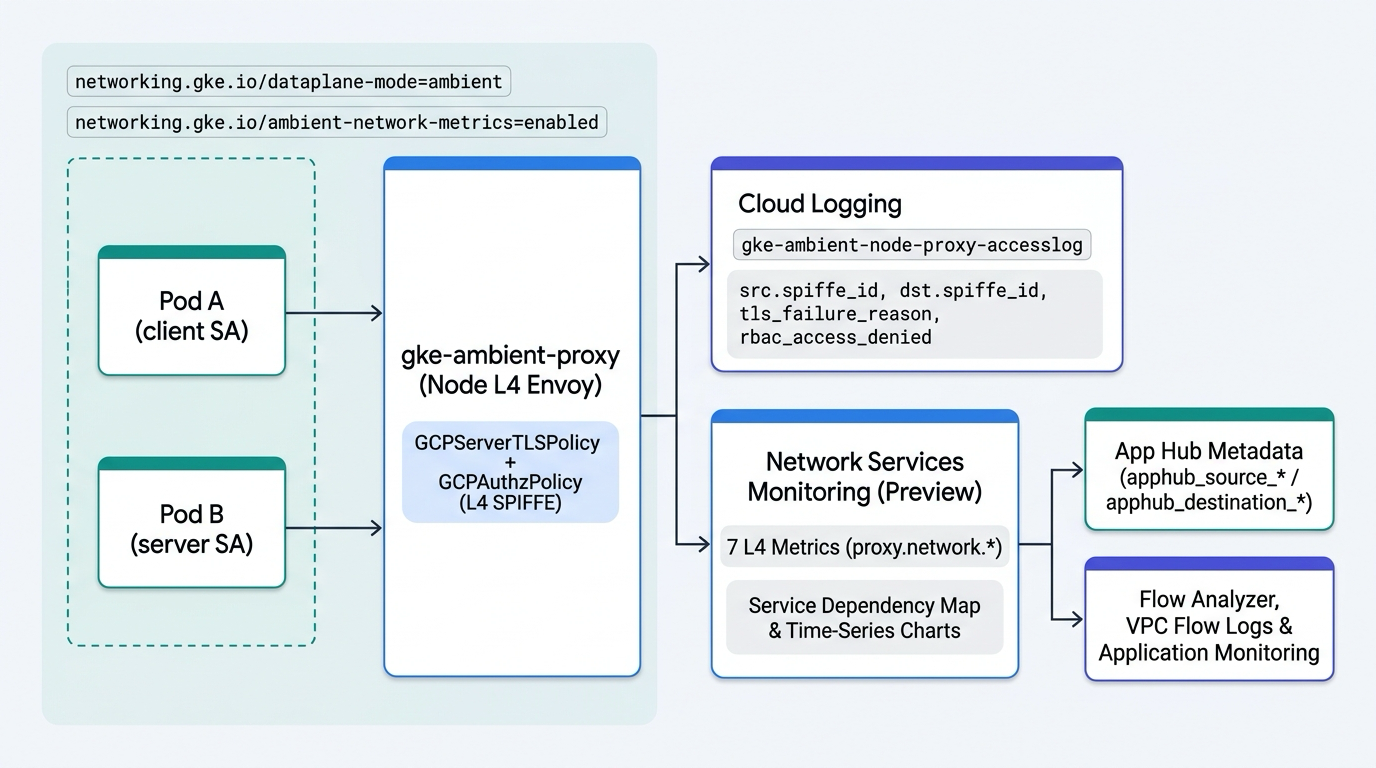 Figure 2: Layer 4 telemetry and audit flow in native GKE ambient networking. The node-level gke-ambient-proxy emits access logs to Cloud Logging and Layer 4 proxy.network.* metrics to Network Services Monitoring, enriched with App Hub metadata and linked to Flow Analyzer.
Enabling L4 Metrics and Granting Access
Telemetry collection is opt-in per ambient-enrolled namespace. Ensure telemetry.googleapis.com and monitoring.googleapis.com are enabled, then add the metrics label:
To inspect discovered services and metrics in the Google Cloud console (Network Intelligence Center > Network Services Monitoring), operators need three viewer roles:
roles/monitoring.viewer(view discovered resources and time-series metrics)roles/apphub.viewer(view App Hub application metadata)roles/container.viewer(view GKE cluster, Service, and Deployment details)
What You Get Out of the Box
In the console, Network Services Monitoring separates Active Discovered Resources (services generating traffic in the selected window) from Inactive Discovered Resources (registered in App Hub with no recent traffic). Selecting a service opens:
- A Service Dependency Map showing inbound and outbound paths with Traffic and Errors overlays.
- Inbound and Outbound connection tables listing every peer source and destination.
- Built-in Dashboard time-series charts for traffic volume, open connections, and connection health.
- Additional Diagnostics deep links straight into App Hub, Application Monitoring, Access logs, VPC Flow Logs, and Flow Analyzer (with pre-populated traffic queries).
Under the hood, the node proxy writes seven Layer 4 metrics under networkservices.googleapis.com/:
Metric (networkservices.googleapis.com/...) | Kind | What It Measures |
|---|---|---|
proxy.network.connection.count | UpDownCounter | Active network connections managed by the node proxy |
proxy.network.connection.duration | Histogram | Distribution of connection lifetimes from establishment to closure |
proxy.network.connection.resets | Counter | Cumulative connections terminated via TCP RST |
proxy.network.connection.timeouts | Counter | Cumulative connections terminated by the proxy due to timeout |
proxy.network.errors | Counter | Cumulative internal errors detected by the node proxy |
proxy.network.io | Counter | Cumulative bytes transmitted and received (throughput) |
proxy.network.tls.handshake.errors | Counter | Cumulative failed TLS handshakes |
If your services are registered in App Hub, Network Services Monitoring automatically enriches every metric with apphub_source_* and apphub_destination_* labels (application ID, service ID, workload ID, criticality type, and environment type), so platform teams can filter network anomalies by business application rather than raw Pod IPs.
Migration Strategy
Because GKE ambient networking cannot interoperate with sidecar-injected workloads (whether on GKE, Compute Engine, or Cloud Run) or proxyless gRPC clients, you cannot simply flip half of a tightly coupled namespace to ambient and expect mTLS calls to cross the boundary.
Plan your transition around clean boundaries:
- Best candidates to move first: Self-contained GKE clusters or namespaces that primarily need mTLS, L4 SPIFFE authorisation, and L4 telemetry, without L7 HTTP canary splitting or hybrid Cloud Run backends.
- Parallel cutover: For existing clusters running
istio-injection=enabled, stand up a clean Dataplane V2 cluster (or an isolated workload boundary) with--enable-ambient-networking, validate policies inPermissivemode, and migrate ingress/callers cleanly rather than mixing sidecar and ambient Pods inside the same call graph. - Where sidecars and Cloud Service Mesh remain the right tool: Multi-region serverless architectures on Cloud Run (as covered in The Global Service Mesh Part 1 and Part 2) still rely on Cloud Service Mesh's managed sidecar or proxyless gRPC, plus
HTTPRouteand L7AuthorizationPolicyprimitives.
Five-Step Verification & Troubleshooting Checklist
When rolling out ambient networking, verify each layer in order before enforcing Strict mTLS and DENY_BY_DEFAULT:
1. Check node DaemonSets are healthy
2. Confirm Pod traffic redirection is active
3. Verify SPIFFE workload certificates are issued
4. Inspect node proxy access logs in Logs Explorer
Look at jsonPayload.src.spiffe_id, jsonPayload.dst.spiffe_id, jsonPayload.tls_failure_reason, and filter jsonPayload.error_details=~"rbac_access_denied" when diagnosing GCPAuthzPolicy drops.
5. Confirm both labels exist if L4 metrics are missing
Network Services Monitoring requires both networking.gke.io/dataplane-mode=ambient and networking.gke.io/ambient-network-metrics=enabled on the namespace, plus active traffic between enrolled Pods.
Architectural Trade-Offs, Scale Limits, and Pricing
Every simplification in infrastructure trades flexibility for operational speed. Here are the current scope boundaries, documented limitations, scale ceilings, and pricing considerations to factor in.
When NOT to Switch Yet
Stay on sidecar-based Cloud Service Mesh (and plan your control-plane migration from ISTIOD to TRAFFIC_DIRECTOR ahead of 1 March 2028, after which Google Cloud states that managed ISTIOD stops receiving updates and security patches and workload sidecars on unmodernised clusters will fail and be unable to send or receive requests) if you depend on:
- Layer 7 traffic management inside the mesh: Weighted HTTP canary splits (such as the 90/10
VirtualServiceexample in my May 2026 post), header-based routing, or HTTP retries/fault injection. - Layer 7 authorisation: Rules inspecting HTTP methods (
GET,POST,DELETE) or URI paths (/api/v1/orders/*). - Multi-cluster or hybrid workloads: Cross-cluster mesh calls or direct mesh communication with GCE VMs, Cloud Run services, or proxyless gRPC clients.
- Unsupported Kubernetes features: Headless Services, the Kubernetes Service
trafficDistributionfield, or GKE Sandbox (gVisor).
Current Scale Limits
GKE Dataplane V2 with ambient networking currently carries tighter cluster ceilings than standard GKE Dataplane V2:
| Resource Metric | GKE DPv2 (with Ambient) | Standard GKE DPv2 (without Ambient) |
|---|---|---|
| Nodes per cluster | 500 | 7,500 |
| Services per cluster | 1,000 | 10,000 |
| Pods per cluster | 5,000 | 200,000 |
| Max Pods per node | 256 | 256 |
Operational Security Notice
Google Cloud's setup documentation includes an explicit security warning: if gke-ambient-nriplugin becomes unavailable on a node, inbound traffic authentication and authorisation enforcement might be bypassed. Treat gke-managed-ambient DaemonSet health alerts as security-critical signals, and keep Kubernetes NetworkPolicy or VPC controls as defence-in-depth where compliance requires fail-closed guarantees.
Pricing (GKE Service Networking)
Ambient networking is billed under GKE Service Networking at $0.00006667 per Pod-minute (in 1-minute increments, identical across all regions). Two details matter for budgeting:
- Billing starts at namespace enrolment: Every running Pod in a namespace carrying
networking.gke.io/dataplane-mode=ambientis billed per minute, whether or not that Pod actively sends mesh traffic. - Additional platform costs apply: The
gke-managed-ambientDaemonSets consume CPU and memory from your GKE node pools (hence thee2-standard-4minimum), and standard charges apply for Cloud Observability (Cloud Monitoring and Cloud Logging) and Certificate Authority Service (CAS).
Illustrative example: 100 Pods running continuously across ambient-labelled namespaces for a 30-day month (43,200 minutes) equals 100 × 43,200 × $0.00006667 ≈ $288.01 per month in GKE Service Networking charges, before node pool compute, Cloud Observability, and CAS usage. Compare that directly against the vCPU and RAM cost of running 100 per-Pod Envoy sidecars plus the engineering time spent draining and restarting Pods for quarterly Envoy CVEs.
Conclusion
Looking back at Scaling Beyond Rehosting, the promise was simple: decouple security and network observability from application containers so teams can modernise without rewriting code. Sidecars delivered that promise, at the cost of coupling Envoy's lifecycle and resource bill to every Pod.
With GKE ambient networking now GA and ISTIOD formally on the deprecation clock, Google Cloud has drawn a clear line. For single-cluster Layer 4 zero-trust networking, mTLS, SPIFFE identity, and zero-dashboard visibility through Network Services Monitoring, the sidecarless Dataplane V2 model is now the cleaner, lower-overhead default on GKE. Keep sidecars (on TRAFFIC_DIRECTOR) for L7 HTTP policies, multi-cluster spans, and Cloud Run hybrid meshes, and drop them everywhere else.
References & Further Reading
- Original Post: Scaling Beyond Rehosting: Transitioning from GCE to GKE with Cloud Service Mesh
- Related Series: The Global Service Mesh (Part 1): Cloud Service Mesh & Cloud Run and Part 2: mTLS & Zero Trust with Authorisation Policies
- Announcement: Introducing ambient networking for GKE
- Concepts: Ambient networking overview
- Setup Guide: Prepare GKE ambient networking
- Authorisation: Configure authorization policies on ambient networking
- Egress (Preview): Route ambient egress traffic through Secure Web Proxy
- Troubleshooting: Troubleshoot ambient networking
- Observability (Preview): Network Services Monitoring overview, View resources and metrics, and Metrics reference
- Pricing & Deprecations: GKE Service Networking pricing and Cloud Service Mesh release notes